Describe the Characteristics of the Five Groups of Pathogenic Microorganisms
Bacteria-tiny simple cells that produce disease in a variety of ways 3. Some common pathogens in each group are listed in the column on the right.
Solved 3 Describe The Characteristics Of The Five Groups Of Chegg Com
Blood and body fluids - HIV Hepatitis B and C.
. Virus bacterium fungus protozoa and helminth. The characteristics of the five groups of pathogenic microorganisms. While these pathogens cause variety of illnesses ranging from minor to life-threatening it is important to note that not all microbes are pathogenic.
Describe the infection cycle and summarize three methods that you can use to break the chain of infec- tion in a medical facility. Characteristics of the 5 groups of pathogenic microorganisms are - 1 BACTERIA- Theses are the microscopic pathogens that reproduce rapidly after entering the body. Describe the infection cycle and summarize three methods that you can use to break the chain of infec- tion in a medical facility.
Examples of capnophilic bacteria include Haemophilus influenzae Neisseria gonorrhoeae etc. Bacteria are single-celled microorganisms that can come in a vast number of species and with a variety of lifestyles. Pathogens must possess the following characteristics to multiply and survive in their hosts.
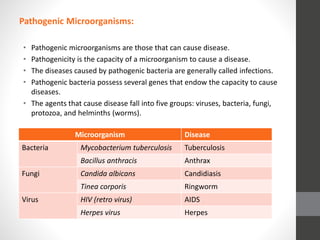
The agents that cause disease fall into five groups. Bloodborne pathogens such as. The degree to which an organism is pathogenic is called virulence.
Microorganisms differ from each other in size and structure habitat metabolism and many other characteristics. There are five main types of pathogens. Bacteria-tiny simple cells that produce disease in a variety of ways3.
There are five main types of pathogens. Bacteria with less than one complete twist or turn have a vibriod shape whereas those with one or more complete turns have a helical shape. The severity of the diseases caused by pathogens is varied.
Different types of include bacteria viruses protists fungi parasitic worms and prions. Transplancental - for example Rubella and HIV. Five groups of pathogenic microorganisms.
The five groups of pathogenic organisms are - bacteria virus fungi worms and protozoa. To be able to multiply using the resources of host. Bacteria are prokaryotic unicellular organisms.
Fungi-may be unicellular or multi-cellular 5. Protozoa-are unicellular parasites that can replicate and multiply rapidly once inside host 4. Pathogenic organisms are of five main types.
And they can release toxins that damage tissues and cause illness. The partial or complete disappearance of the clinical and subjective characteristics of a chronic or malignant disease. To be able to refrain from destruct and overcome the adaptive and innate immune responses of the host cells.
Some microorganisms have more than one means of escape - for example chickenpox can be spread via respiratory source or the patients skin. Some infections are mild whereas others could be life-threatening. The bacteria may be spherical rod-like spirally coiled or filament like.
Medical health infectious diseases. Viruses-smallest of all pathogens disease causing agent. Invade or colonize the host and escape.
Pathogens are microscopic organisms that cause or potential to cause disease. Protozoa-are unicellular parasites that can replicate and multiply rapidly once inside host4. Spirilla are rigid helical bacteria whereas spirochetes are highly flexible.
Describe the characteristics of the five groups of pathogenic microorganisms. The average size of a bacterium is around 2 µm. Microorganisms are microscopic which includes bacteria fungi archaea or protists.
List The Major Groups Of Microorganisms. Viruses-smallest of all pathogens disease causing agent. Protozoa and worms are usually grouped togetheras parasites and are the subject of the discipline of parasitology whereasviruses bacteria.
The characteristics of the five groups of pathogenic microorganisms. The ability of a pathogen to cause disease is called pathogenicity. Th View the full answer.
The human body has several natural protective mechanisms to defend itself from infections. Viruses bacteria fungiprotozoa and helminths worms. Higher oxygen tensions may be inhibitory to them.
Describe the characteristics of the five groups of pathogenic microorganisms. Locate a spot in the host which is richly supplied with nutrition. Skin - for example scabies impetigo.
Bacteria are microscopic pathogens that reproduce rapidly after entering the body. Click to see full answer. Curved bacteria are usually curved with a twist.
Characteristics of Pathogenic Bacteria. Caused by organisms that are not typically pathogenic but that occur in hosts with an impaired immune system. Some of them are free living not requiring other organisms for their survival and existing in everything from the soil and fresh water to extreme environments such as deep ocean.
Bacteria are the tiny organisms which are not visible to the naked eye they can be seen only under microscope. Microaerophiles mipkro-aero-filz are those groups of bacteria that can grow best under reduced oxygen 5 to 10 and increased carbon dioxide 8 to 10 concentrations. They can release toxins that damage tissues and cause illness.
Most bacteria are harmless or helpful but some are pathogens causing disease in humans and other animals. CHARACTERISTICS OF BACTERIA. Certain bacteria may occur in more than one form.
They lack organized nucleus but possess a rigid cell wall comparable to that found in plants. Describe the characteristics of the five groups of pathogenic microorganisms. 455 695 Views.
27 Votes A variety of microorganisms can cause disease. Viruses bacteria fungi protozoa and worms.
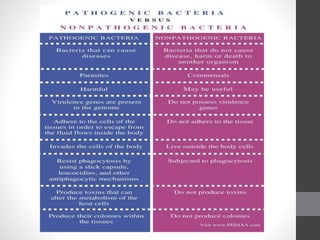
Classification Of Pathogenic And Non Pathogenic Microorganisms Medic
Classification Of Pathogenic And Non Pathogenic Microorganisms Medic

Prokaryote Classification And Diversity Article Khan Academy


Comments
Post a Comment